
Subtotal 0,00 د.إ
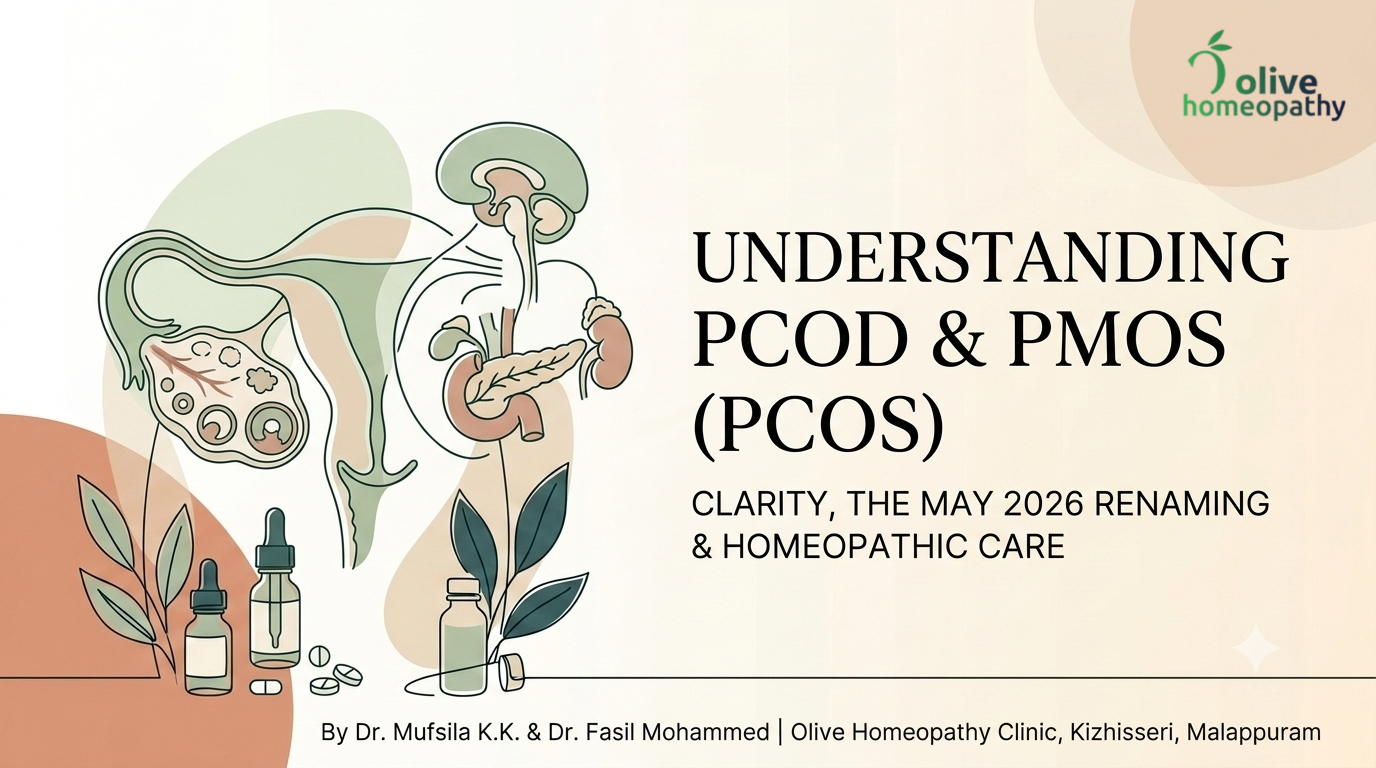
By Dr. Mufsila K.K. (BHMS) | Reviewed & Co-Authored by Dr. Fasil Mohammed | Olive Homeopathy Clinic, Kizhisseri, Malappuram
Last updated: August 2026 — reflects the May 2026 global PCOS-to-PMOS renaming published in The Lancet
About the authors: Dr. Mufsila K.K. (BHMS) is a homeopathic physician at Olive Homeopathy Clinic, Kizhisseri, Malappuram, focused on female endocrine health, natural fertility support, and PCOD/PMOS care. Dr. Fasil Mohammed is Chief Homeopathic Physician at the clinic, with extensive experience managing chronic metabolic and lifestyle disorders. Both see patients in-clinic and via tele-consultation.
If you are searching for clarity on PCOD vs PCOS (Polycystic Ovarian Disease vs Polycystic Ovary Syndrome) while dealing with irregular periods, stubborn weight gain, or hormonal acne, you are not alone.
There’s also a real, recent update worth knowing: in May 2026, the global medical community formally renamed PCOS to PMOS (Polyendocrine Metabolic Ovarian Syndrome). At Olive Homeopathy Clinic in Kizhisseri, Malappuram, we believe clear information is the first step toward effective care — so here’s what changed, how PCOD and PMOS compare, and how constitutional homeopathy combined with structured lifestyle support can help you manage symptoms naturally.
PCOD vs. PMOS (PCOS): How They’re Usually Compared
Doctors don’t fully agree on this point — some use PCOD and PCOS interchangeably as regional names for the same condition, while others, especially in Indian clinical practice, treat PCOD as a generally milder presentation and PMOS/PCOS as the more complex metabolic syndrome. Here’s the distinction commonly drawn in practice:
| Clinical Parameter | PCOD (Polycystic Ovarian Disease) | PMOS / PCOS (Polyendocrine Metabolic Ovarian Syndrome) |
|---|---|---|
| Typical Presentation | Hormonal imbalance with immature egg accumulation in the ovaries | Broader neuro-endocrine and metabolic dysfunction, with or without ovarian cysts |
| Ovarian Findings | Multiple partially developed follicles | May or may not show cysts; marked by androgen excess and insulin resistance |
| Metabolic Involvement | Usually milder impact on glucose metabolism | Higher association with insulin resistance and metabolic syndrome |
| Course | Often improves with dietary and lifestyle changes | Typically needs longer-term, comprehensive management |
Note: if a doctor has told you your PCOD and PCOS labels mean the same thing, that’s also a valid and common clinical view — the terms are used inconsistently across India and internationally.
Why Was PCOS Renamed to PMOS?
The term “Polycystic Ovary Syndrome” dates back to 1935, when physicians first observed enlarged ovaries with small fluid-filled sacs. But the name misled many people into thinking cysts were required for diagnosis — leading to years of confusion and delayed care for women whose scans looked normal.
In May 2026, a global consensus effort involving 56 academic, clinical, and patient organisations — including the Endocrine Society and more than 14,000 patient and clinician survey responses — published new terminology guidelines in The Lancet, officially renaming PCOS to Polyendocrine Metabolic Ovarian Syndrome (PMOS).
What the New Name Reflects
- Poly-Endocrine: The condition isn’t limited to the ovaries — it involves the pituitary, adrenal glands, pancreas, and thyroid.
- Metabolic: Insulin resistance and systemic inflammation are recognised as major drivers of symptoms, not side effects.
- Ovarian: Irregular cycles and anovulation are now understood as a downstream result of the broader imbalance, not the root cause.
“For years, many women were told their hormones were fine simply because a scan showed no ovarian cysts. Naming it PMOS pushes us to look at the whole endocrine and metabolic picture, not just an ultrasound image.”
— Dr. Fasil Mohammed, Chief Homeopathic Physician, Olive Homeopathy Clinic
Common Signs of PMOS and PCOD
- Menstrual irregularity: delayed cycles, missed periods, or unpredictable heavy bleeding
- Androgen excess: facial hair growth, jawline acne, thinning scalp hair
- Metabolic signs: central weight gain, carbohydrate cravings, dark patches of skin (acanthosis nigricans)
- Mood and energy: anxiety, low mood, afternoon fatigue, brain fog
How Homeopathy Approaches PCOD and PMOS
Conventional treatment for PCOD and PMOS often relies on hormonal birth control or insulin-sensitising medication to manage symptoms. These can help in the short term but don’t address why the imbalance developed in the first place.
Homeopathy takes a constitutional approach — looking at your individual physical, metabolic, and emotional pattern rather than treating “PCOD” or “PMOS” as one generic label. The goal is to support your body’s own regulatory capacity over time, alongside — not necessarily instead of — your gynaecologist’s monitoring and advice.
Constitutional Homeopathic Care
HPO-Axis Support (Pituitary–Ovary signalling) + Metabolic & Insulin Sensitivity Support
↓
Individualised remedy selection based on full case history
↓
Supports regular cycles, skin health, and metabolic balance over time
1. Constitutional Remedies
At Olive Homeopathy Clinic, treatment starts with a full case study — your physical build, metabolic tendencies, thermal sensitivity, and mental-emotional state. Remedies such as Pulsatilla, Sepia, Calcarea Carbonica, Lachesis, and Thuja are considered based on your specific symptom pattern, not a diagnosis label alone.
2. Supporting Insulin Sensitivity
Constitutional treatment is used alongside diet and lifestyle changes with the aim of supporting healthier blood sugar regulation, which may in turn help reduce the androgen excess linked to PMOS symptoms.
3. Supporting Natural Ovulation
By working with the hypothalamic-pituitary-ovarian (HPO) axis, the aim is to support your body’s own cycle regularity and natural ovulation over time rather than inducing a withdrawal bleed with synthetic hormones. For women planning a pregnancy, this approach forms an integral part of our homeopathy infertility treatment in Kerala.
4 Lifestyle Pillars for Hormonal Balance
- Low-glycemic, anti-inflammatory diet: whole grains, leafy greens, healthy fats (chia seeds, walnuts, olive oil), adequate protein; minimise refined sugar and processed flour.
- Strength training + low-cortisol movement: combine resistance training with walking and yoga rather than excessive high-intensity cardio, which can raise cortisol.
- Sleep and stress management: aim for 7–8 hours of sleep; chronic stress raises adrenal androgen output.
- Reduce xenoestrogen exposure: switch from plastic to glass or stainless steel food storage to limit endocrine-disrupting chemicals.
Frequently Asked Questions
Is PCOD easier to manage than PMOS (PCOS)?
PCOD is often milder and may respond to lifestyle changes and shorter-term homeopathic support. PMOS involves broader metabolic and endocrine pathways and typically needs a longer, structured constitutional treatment plan.
Can homeopathy help regulate periods without birth control pills?
Homeopathy doesn’t use synthetic hormones to force a withdrawal bleed. Constitutional treatment aims to support your body’s own ovulatory rhythm over time, alongside diet and lifestyle changes.
Why was PCOS renamed to PMOS in 2026?
A global consensus of 56 organisations, published in The Lancet in May 2026, renamed PCOS to Polyendocrine Metabolic Ovarian Syndrome (PMOS) to reflect that the condition affects multiple hormone systems and metabolic health — not just the ovaries — and to correct the misconception that cysts are required for diagnosis.
How long does homeopathic treatment take for PCOD or PMOS?
Many patients notice changes in energy, skin, and cycle regularity within 3–6 months of constitutional treatment. PMOS is generally a long-term condition, so ongoing management and monitoring is usually needed.
Book a Consultation at Olive Homeopathy Clinic
Dr. Mufsila K.K. and Dr. Fasil Mohammed offer in-clinic and tele-consultations for PCOD, PMOS (PCOS), and other hormonal concerns.
Grace Mall, Balathilpuraya, Kizhisseri, Kuzhimanna, Malappuram, Kerala – 673641
Meet the Doctors
Dr. Mufsila K.K. (BHMS) — Homeopathic physician specialising in female endocrine health, natural fertility support, and PCOD/PMOS care, with an integrated lifestyle approach.
Dr. Fasil Mohammed — Chief Homeopathic Physician at Olive Homeopathy Clinic, with extensive experience managing chronic metabolic and lifestyle disorders.
Medical Disclaimer: This article is for educational purposes only and is not a substitute for professional medical advice, diagnosis, or treatment. PMOS is a recognised long-term metabolic condition; please continue regular monitoring with your gynaecologist or endocrinologist alongside any homeopathic care. Always consult a qualified physician for individualised guidance. Source: Bahri Khomami et al., “Polyendocrine metabolic ovarian syndrome, the new name for polycystic ovary syndrome,” The Lancet, May 2026.
